Arizona’s Environmental Convening Is Ground Zero for Extreme Heat. It Is Also the World’s Blueprint for What Comes Next.
By: Nicolas de la Fuente, Director of Environmental Strategy, Arizona Community Foundation
I spend a lot of time outside.
Not in conference rooms, but in the 6 biomes where Arizona’s ecosystems match the diversity and sophistication of the leadership working to preserve Arizona’s future. From the ancestral farming techniques informed by celestial storytelling on the Navajo Nation, to solar panels over canal waters, to the agrivoltaics operations covering Tucson elementary school gardens, to the cool pavement program on Phoenix streets, to the micro-grid work in Tucson, to the one-rock dams in the borderlands, to the ambitions for Superior, AZ to become the healthiest rural community in the country, there is no shortage of innovation and leadership in Arizona.
I have shared meals and conversations with farmers, community organizers, and frontline workers doing extraordinary things. What they share is not resignation. It is resolve, and a unique desire to weave a biomimicry quilt that showcases the connectivity of these efforts across Arizona for the world to see.
That is the Arizona I want to tell you about.
Ground Zero Is Also the Starting Line
Phoenix consistently ranks among the top 10 hottest cities on the planet. Extreme heat is the deadliest weather-related hazard in our state and our nation, with impacts that extend well beyond public health to affect economic productivity, infrastructure, food systems, and quality of life across every corner of Arizona. A Nature Conservancy study found that if no action is taken, rising extreme heat could cost the Phoenix metro area approximately $2 billion every year in losses to human health, labor productivity, energy, and infrastructure. (The Nature Conservancy, “Economic Assessment of Heat in the Phoenix Metro Area,” 2021. nature.org)
Urban sprawl and the urban heat island effect have created a challenge incomparable to historical realities where temperatures dropped significantly at night. And we find ourselves at a juncture in history where new, smarter growth coincides with antiquated development efforts of the past. Poorer areas of our cities can reach temperatures up to 7 degrees hotter than wealthier neighborhoods — a disparity confirmed by peer-reviewed research from the University of California San Diego, published in the journal Earth’s Future, which found that in 71 percent of U.S. counties studied, communities with higher rates of poverty experienced land surface temperatures up to 7 degrees Fahrenheit warmer than the wealthiest neighborhoods during summer months. (Benz and Burney, “Inequity in U.S. Urban Heat Exposure,” Earth’s Future, 2021. today.ucsd.edu) Those heat gaps tend to follow the same patterns as longstanding health and economic inequalities across our communities. Research on these disparities is plentiful, available, and not new. It’s not surprising, and unfortunately, it’s no longer jarring. It’s the status quo.
Adjacent to the status quo realities of our environmental, housing, and educational challenges is that of the nonprofit and philanthropic community in which we operate. Like every sector, philanthropy has an opportunity to evolve. We find ourselves in familiar waters, shaped by how our systems were built around the individual goals of individual institutions, individual nonprofits, and individual donor and foundation interests. In other words, the abundance adage is correct, but what lacks is thoughtful, strategic coordination of the puzzle pieces.
Scattered Lots
Right now, Arizona’s environmental funding landscape is like scattered lots — individual parcels with passionate owners, but no roads, no zoning, no infrastructure. You can build something, but scaling proves difficult. ACF’s environmental strategy is a master-planned approach: shared infrastructure, coordinated investment, aligned utilities. It’s not about owning every parcel; it’s about ensuring every community in Arizona can grow and thrive.
Consider this: according to the Milken Institute’s report “Priorities for Strategic Climate and Environmental Philanthropy” (2025), only about 2 percent of global philanthropic contributions are directed toward environmental and climate mitigation — despite the escalating impact of extreme heat, water scarcity, and ecological disruption on communities worldwide. In Arizona, where environmental causes rank among the lowest-funded categories in the state’s philanthropic landscape, the gap between what is needed and what is currently invested is even more stark. Arizona’s donors have an extraordinary opportunity to change that calculus for our state — and to model what strategic, coordinated environmental investment can look like for the rest of the country. (Milken Institute, “Priorities for Strategic Climate and Environmental Philanthropy,” February 2025. milkeninstitute.org)
Additionally, big environmental issues like extreme heat are complex and touch every sector of society. And as such, they can immediately feel overwhelming and unachievable to the average person, donor, or nonprofit entity. A donor or local foundation might ask: why not secure my investment and my legacy around something I can change and have a real impact on? How can I, as one donor, change the 7-degree temperature disparity in the nation’s 5th largest city? How can we, as one foundation, solve for such complex water issues in the American Southwest?
Here is our big bet. You can, but only through a level of coordinated investment never done before. Nobody can solve these issues alone. No sole institution, municipal government, state government, university, or even the federal government can solve these issues by themselves. It’s clear, and it’s known: these issues will require an unprecedented cross-sector collaborative effort to steer toward a better trajectory for future generations.
“Nobody can solve these issues alone. No sole institution, municipal government, state government, university, or even the federal government can solve these issues by themselves.”
— Nicolas de la Fuente, Director of Environmental Strategy, Arizona Community Foundation
What we can, should, and need to do is lay the foundation for the cross-sector collaboration at scale that Arizona is ready for. And that is what Arizona’s Environmental Convening seeks to achieve. Arizona’s Environmental Convening aims to build the pathways for the next decade of slow, steady, methodical, collaborative growth that will ensure a healthy, livable future for Arizona.
From the Bottom Up
To date, environmental goals have been top-down driven from global bodies to individual countries and down the line to local communities. But how can goals set in Geneva or Washington truly address what is happening in Maryvale? How can priorities shaped at a distance serve Superior? Arizona has an opportunity to flip the script — building a localized movement from the ground up so that community-driven solutions can inform state and national strategies, rather than the other way around. A locally grounded approach, standing apart from top-down global mandates, is something leaders across the political spectrum can rally behind.
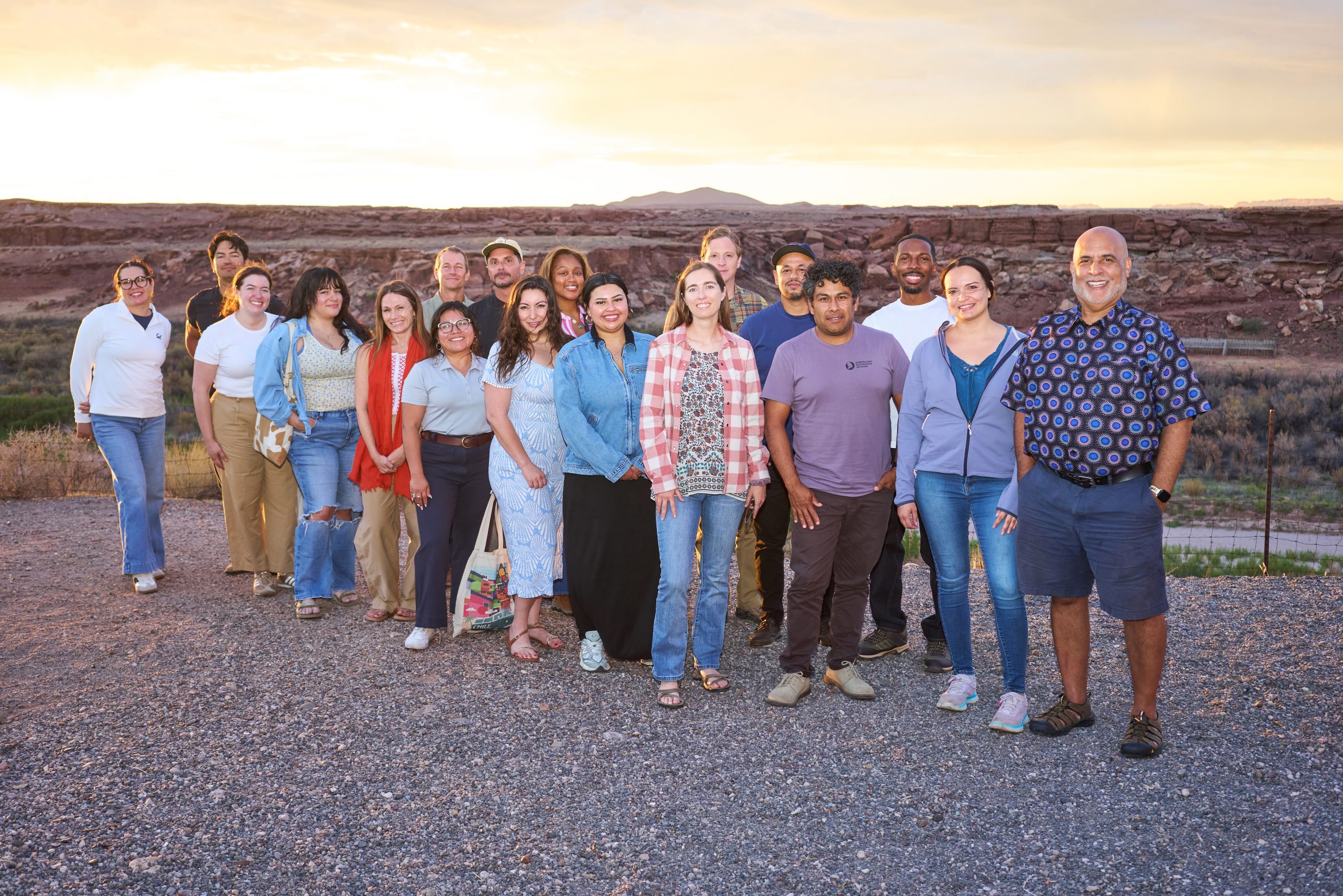
To set this movement in motion, ACF launched the Environmental Accelerator Project in Greer, AZ, in September 2024, forming new pathways to cross-sector collaboration between philanthropy and nonprofits. In June 2026, ACF convened the second year of the Accelerator, deepening those partnerships and expanding the coalition of leaders committed to this work. It has not been perfect, and many lessons have been learned, but the Accelerator has revealed the overwhelming desire and interest to build upon the model. It is through the lens of this shadow future, and through the framework of the adjacent possible, that we are scaling our efforts at Arizona’s Environmental Convening.
What emerged from the Accelerator is the illuminating connectivity and complementarity between the work happening across the state and across sectors — but more importantly, around the grit, determination, and brilliance of the day-to-day leaders driving this work.
Historically, philanthropy has encouraged nonprofits to consolidate efforts and rarely has looked in the mirror to ask: how do we scale our own collaborative efforts and connectivity? How do we scale this shadow future of collaboration focused on partnership and dynamic subordination? The Accelerator gave us a framework to scale at Arizona’s Environmental Convening and supplied the questions that need to be solved if we want to be leaders in the environmental space.
How does this movement unite our state and provide runways for partnership with local donors and national funders? How will our success be measured by future generations benefiting from our efforts beyond a short-term assessment of number of attendees and inspiring keynote speakers? This answer is found in how we bring people together and our thorough attention to human connection across sectors, roles, and resources.
The Journey Is Equally as Important as the Destination
Arizona’s Environmental Convening will inspire the country. Through our collective national networks, we will bring together national and global partners to share best practices and highlight the innovation happening in Arizona. But what is much more important than highlighting the great work is the collapsing and coordination of efforts as a result of the convening planning process itself. Movements are heavily dependent on timing — the civic climate, institutional leadership, the urgency of the issues, the will of the people. And this is where we find ourselves today. Extreme heat and water will inform the future of Arizona’s cities; a shifting funding landscape at every level has created a new urgency in the sector, and an opening for Arizona to lead with locally driven, privately supported solutions. Serendipitously, we have brilliant leaders transforming our bedrock institutions outward, to be more community-focused than historically inward-focused. The leadership is here. The issues are real. The time is now.
The New Localism: Creative Coalitions
Through the vehicle of Arizona’s Environmental Convening, we have unlocked unprecedented partnerships that have the possibility to transform Arizona’s environmental philanthropic landscape. We have uncovered a network of aligned and willing partners and efforts right below the surface that just needed sunlight for germination and growth. The unlikely combination of Desert Botanical Garden alongside a global outfit like The Nature Conservancy, alongside local municipalities, nonprofits, Tribal Nations, and universities is precisely what it will take to coordinate and build scale-ready models for future expansion. Form follows function, so how do these collaborative efforts attract the scale of funding required to catalyze real impact versus the small-scale, individualized funding efforts of the past?
How do we bridge the heat mitigation efforts between Tucson and the Phoenix metro region? How do we better coordinate both investments and fund development efforts in a shared, coordinated fashion that aligns community outcomes alongside individual institutional financial growth? How can the success of strategic plans from our bedrock institutions be tied to the extreme heat mitigation efforts in communities like Maryvale? How can the individual interest of a DAF holder be tied to Regenerating Sonora’s goal to make Superior the healthiest rural community in America? How can the individual efforts of our utility companies and nonprofits focused on increasing shade canopies be coordinated and tied to municipal shade plans? How can philanthropy build collaborative budgets to scale these coordinated efforts? These are the questions that will decide the future of philanthropy, and Arizona’s Environmental Convening will be the vessel to make it happen.
Collaboration Is Hard: Building Trust Across the Table
Arizona’s Environmental Convening has the possibility of becoming the localized, community-driven convening equivalent of the United Nations Conference of the Parties at the Arizona level. But unlike global environmental mandates that lack localized context and nuance, Arizona’s Environmental Convening will present real-time, tangible, scalable projects ready for investment and partnership. However, we run the risk of replicating these top-down global systems if we are not mindful and strategic in addressing the localized dynamics that exist between nonprofit and philanthropic entities, universities, and the systemic competition for limited philanthropic resources.
The elephant in the room is not hidden, and a core function of ACF’s environmental strategy is to name the source of the challenge around limited resources and uneven fundraising capacity between larger legacy organizations and smaller startups and mid-sized nonprofits. When outcomes are shared across partners of all sizes, the total resources available to the entire state grow — not just for those who have historically had the closest access.
What makes this work different is its design. We deliberately build spaces where Tribal Nation leaders, small farmers, municipal leaders, nonprofit organizers, researchers, and local and national foundations sit as equal contributors to the same challenges. Building trust across these relationships is not a side note in this work. It is the architecture, and the environments in which we convene matter.
Over the next couple of months, community leaders will come together all across the state of Arizona in preparation for Arizona’s Environmental Convening. Leaders will be convening on tribal nations, in the borderlands, in Tucson, in Phoenix, in Superior, and in all different areas of the state. We are building workshops and convening outcomes from the ground up. Foundations and funders will be invited as equal contributors in these convenings to ensure the results of our efforts are being driven by those closest to the work, and the momentum we build will carry over into a celebration at Arizona’s Environmental Convening of what we have achieved together.
Arizona’s Environmental Convening Is a Celebration, Not an Introduction
On December 2 and 3, 2026, in downtown Phoenix, the Arizona Community Foundation will co-present the inaugural Arizona’s Environmental Convening alongside Arizona State University and its Ten Across initiative, the City of Phoenix, The Nature Conservancy, and Desert Botanical Garden — along with hundreds of nonprofit leaders from across the state, country, and world.
Arizona’s Environmental Convening is built on a simple belief: that the most powerful outcomes emerge not from a single keynote or panel, but from the relationships and commitments built between people who would not otherwise be in the same room. What sets this convening apart is its design around action and accountability. Investment-ready projects are identified in advance, and partnerships between funders and community leaders are nourished during statewide preparatory convenings so that by the time we reach December 2nd we should be deciphering scale versus making introductions. National and local funders arrive briefed and ready to engage.
Where other convenings showcase ideas, Arizona’s Environmental Convening leads with innovation, partners, and defined capital needs. It brings together cross-sector leaders from across Arizona alongside local and national funders to build pathways for scalable collaboration and growth, with concurrent workshops tied to specific projects in extreme heat, conservation, and food systems, and a curated field visit so funders can see the work in progress. This is not a convening about extreme heat. It is a coordination point for capital already in motion.
Arizona’s Environmental Convening — A Different Kind of Gathering
A Call to Community
The leaders I have met across this state are not waiting for permission to build a better Arizona. They are already doing it. Our role at ACF is to ensure that resources find them, that coordination infrastructure exists to scale their work, and that Arizona’s story of resilience and innovation reaches the national audiences ready to invest in it.
“The leaders I have met across this state are not waiting for permission to build a better Arizona. They are already doing it.”
— Nicolas de la Fuente, Director of Environmental Strategy, Arizona Community Foundation
The challenge is real. The leadership is here. The innovations and solutions are rising. The time is now.
If you are ready to be part of this work, we invite you to support Arizona's environmental future by investing in ACF’s Environmental Fund.
Give to ACF's Environment Fund
Nicolas de la Fuente serves as Director of Environmental Strategy at the Arizona Community Foundation, where he leads convening, learning, and partnerships to advance statewide environmental strategy. He is co-founder of Spaces of Opportunity, a 19-acre urban agriculture and community wellness project in South Phoenix, and previously launched Arizona’s first outdoor summit on extreme heat and environmental resilience. He holds a master’s degree in Human Rights Research from Arizona State University and spent two years supporting food security work in Guatemala with the U.S. Peace Corps.